Whole-Building Compartmentalization Test in Pomona

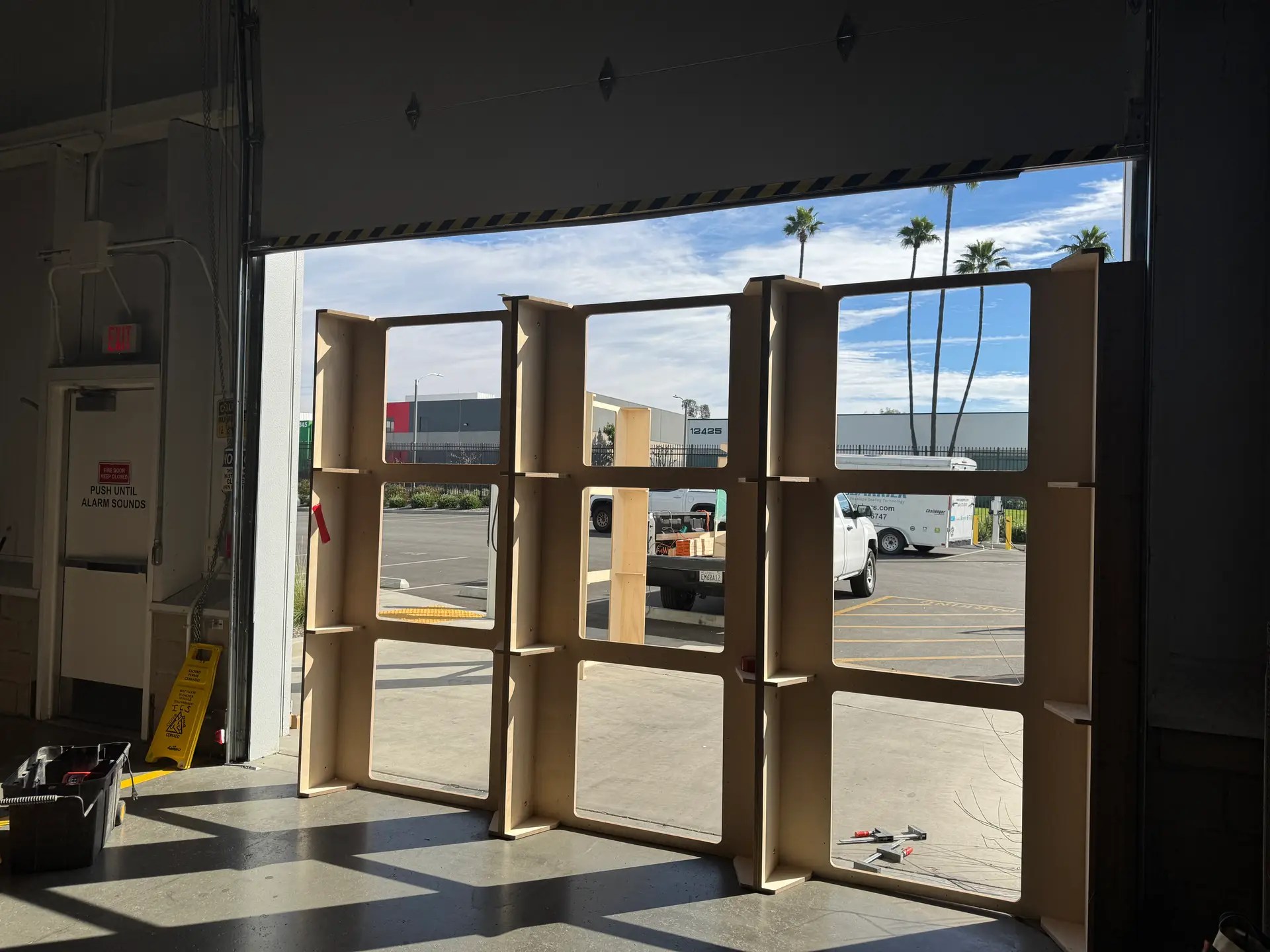
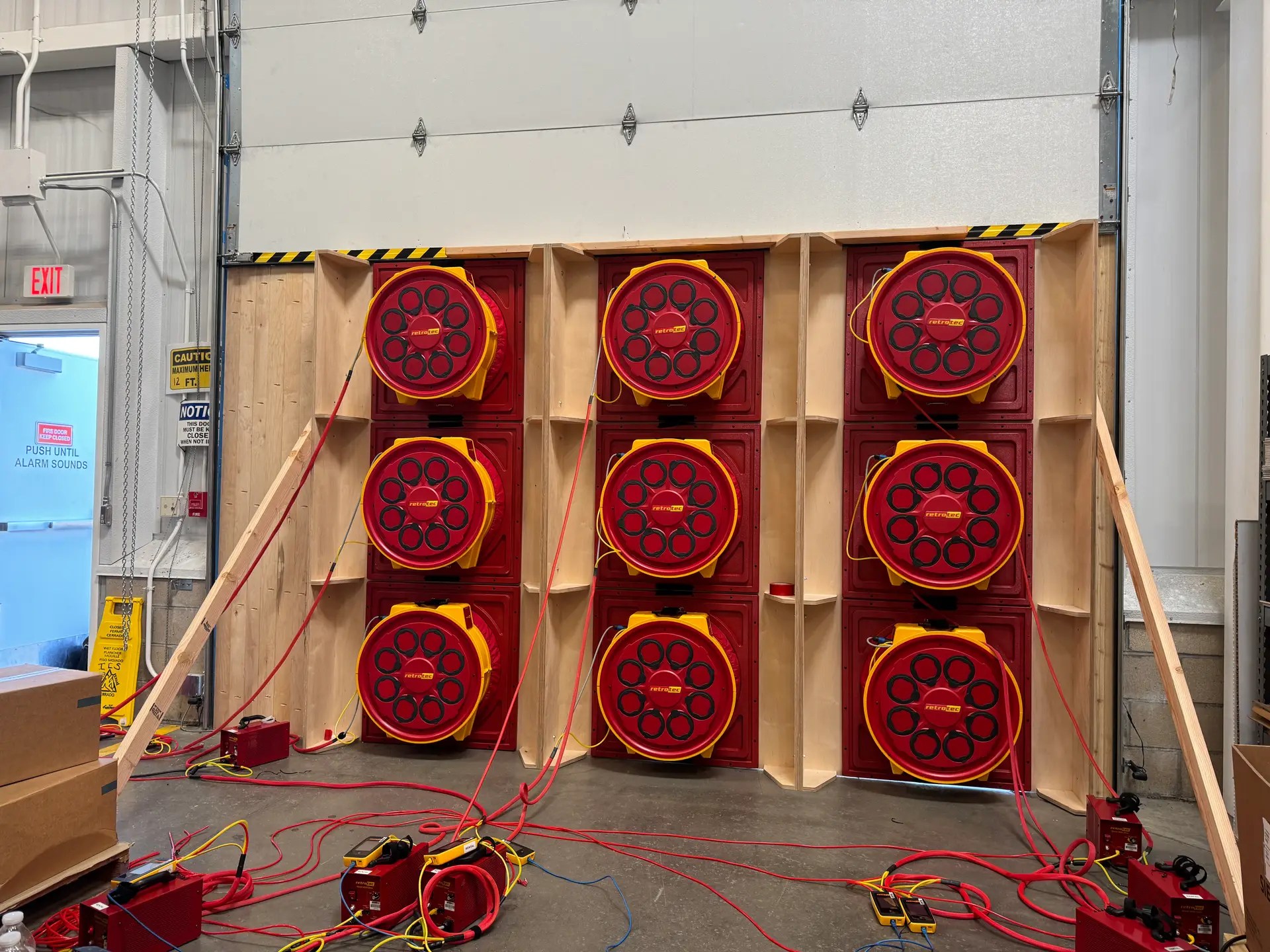
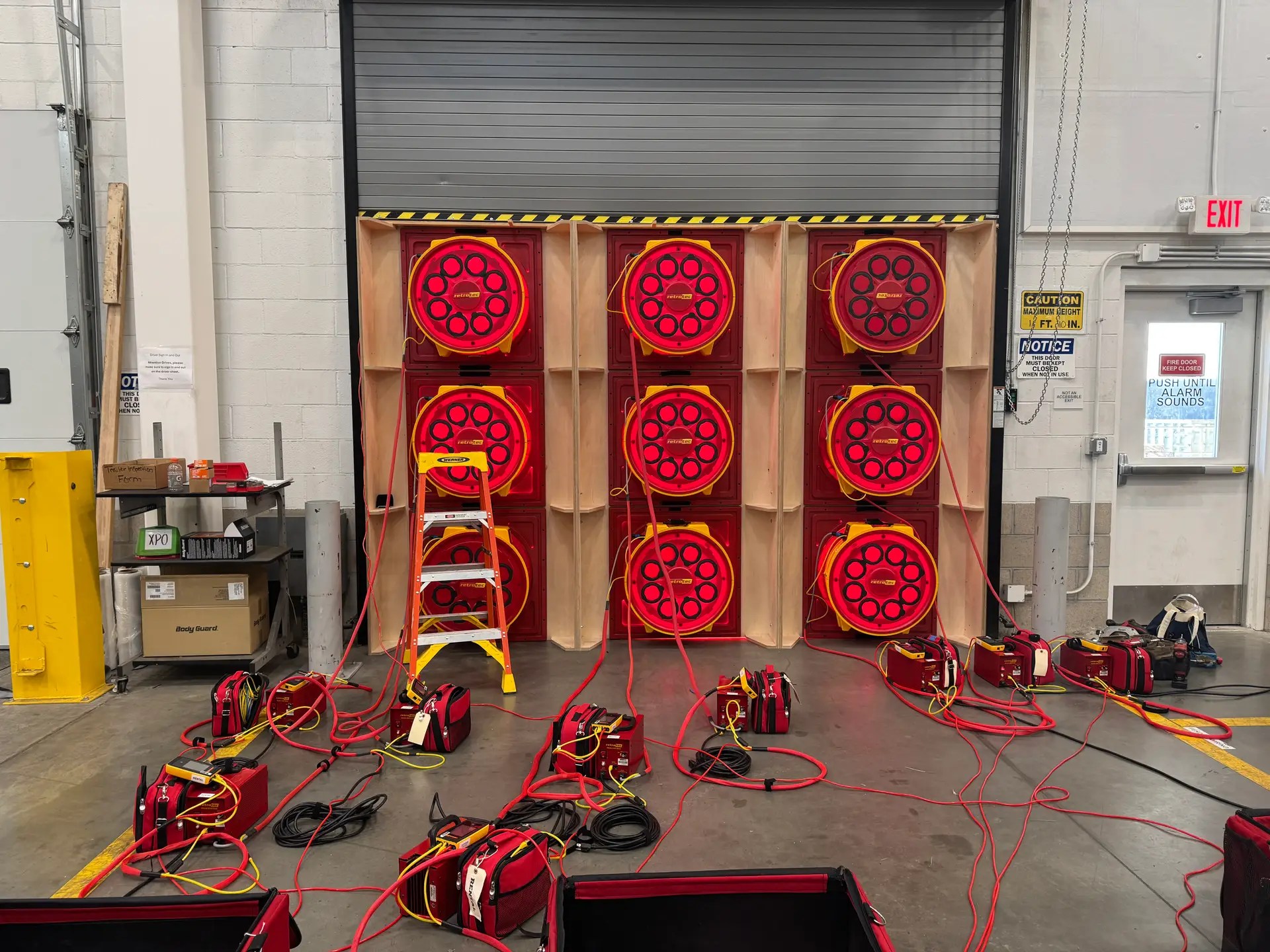
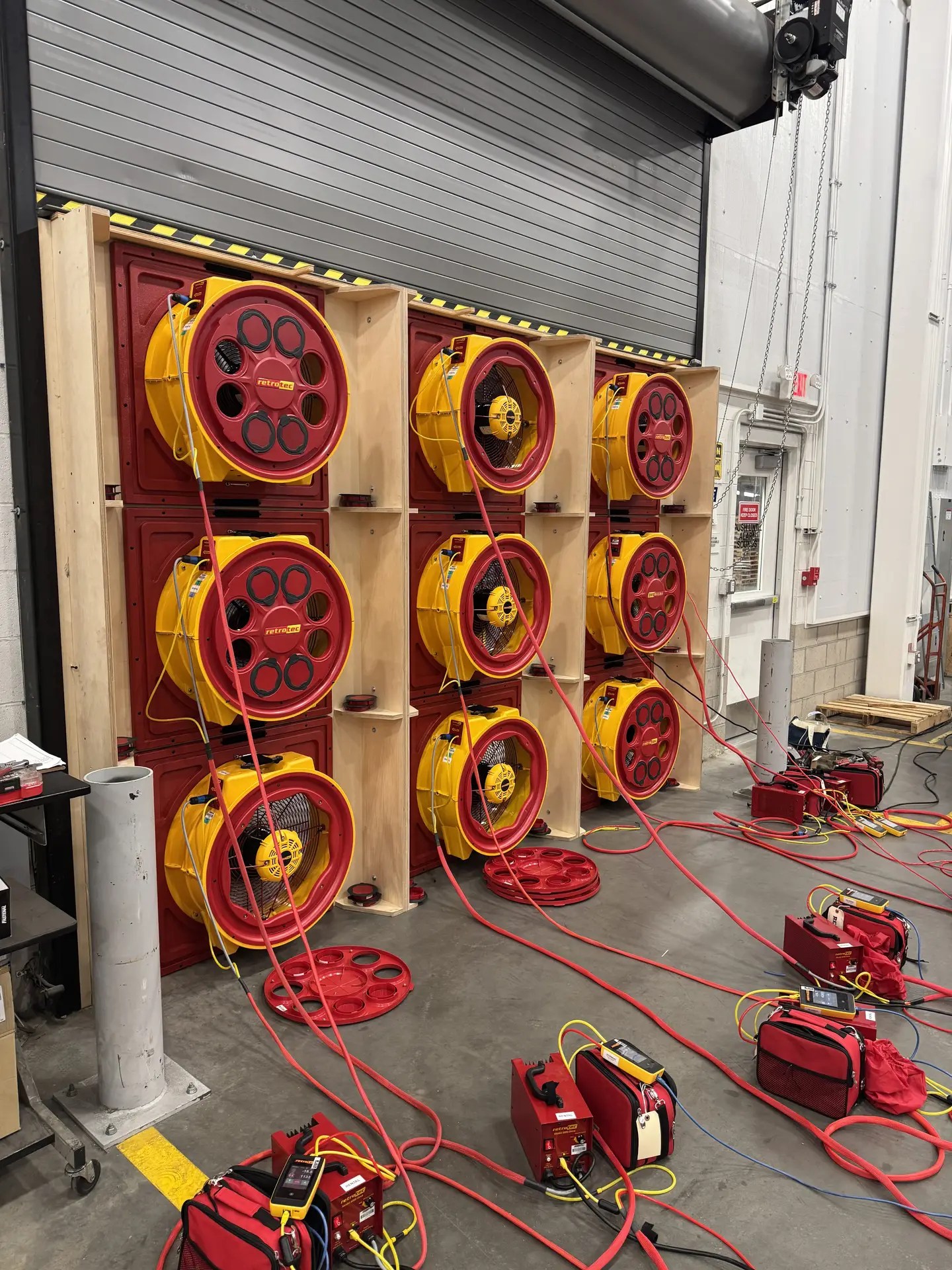
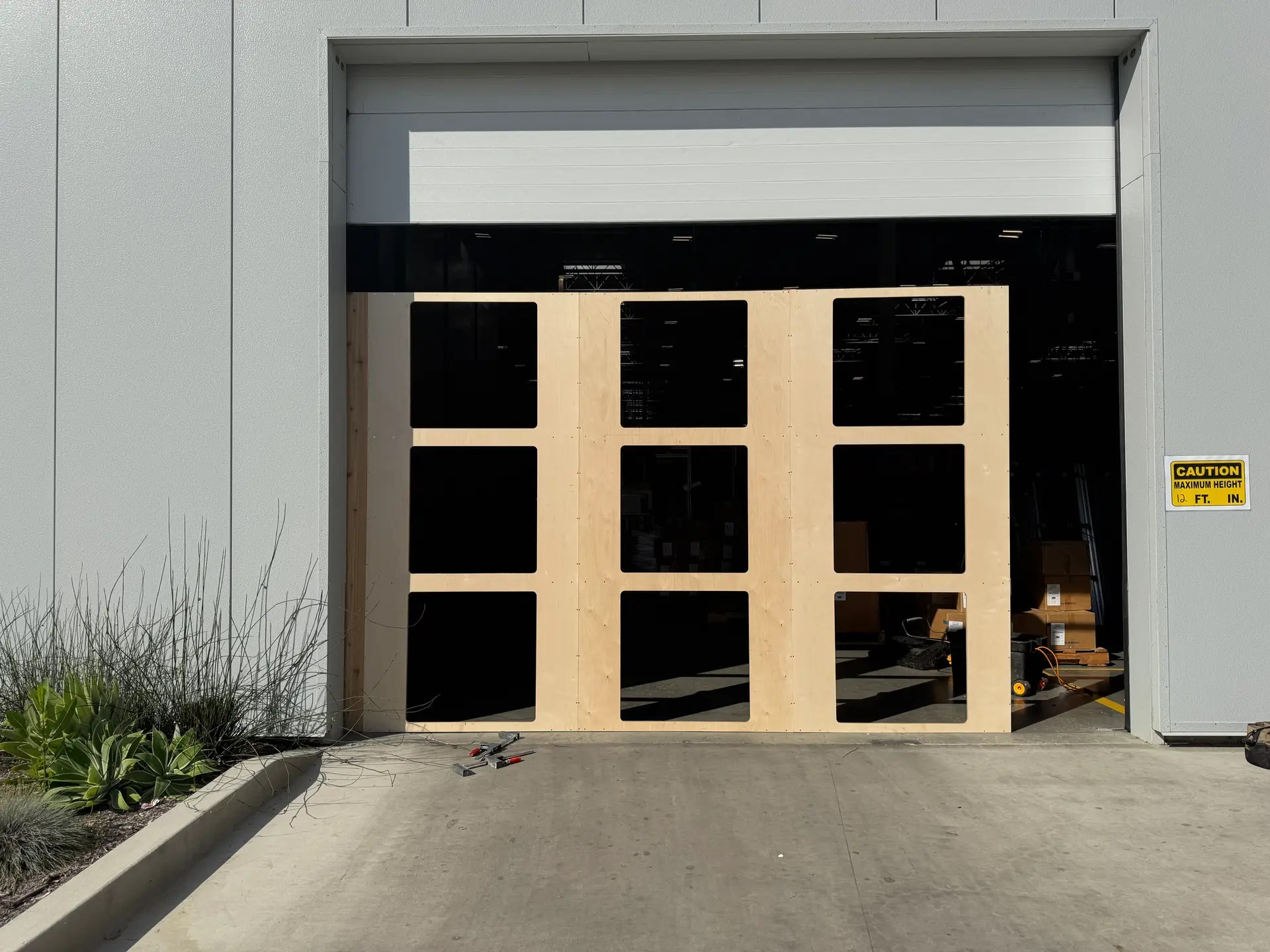
Nine fans set up on one of the large doors at the new Siemens facility in Pomona, CA.
The Wellwater Project in Pomona, California, marks an important expansion for Siemens, a multinational technology company focused on industry, infrastructure, transportation, and healthcare. The project will build a new, 150 thousand square feet manufacturing space with the primary goal of improving production efficiency to meet the growing demand for Siemens’ electrical products used across industrial, commercial, and construction markets. In addition to increasing capacity, the project is designed with sustainability at its core and carbon-neutral operating as well as becoming the first LEED Gold–certified industrial building in Pomona.
As part of these sustainability and performance goals, our team was brought in to conduct a large compartmentalization test, also known as large or whole-building blower door tests. The test measures how much air unintentionally leaks out of a building through gaps in its enclosure. While blower door tests are common for residential construction, performing it for large industrial facilities requires significantly more planning, coordination, and equipment.
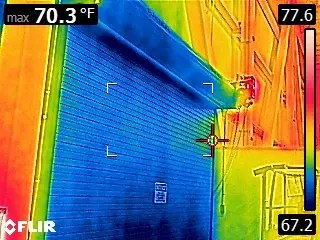
To successfully perform our test, we installed 18 high-capacity fans across two large door entrances and conducted 15 diagnostic tests under different air pressure conditions. The total testing volume of the tests was over 5.1 million cubic feet. By temporarily pressurizing and depressurizing the building, we were able to simulate real-world environmental forces such as wind and temperature differences. Sensors and monitoring equipment then measured how much air was escaping, which helps determine whether the building enclosure meets performance targets and industry benchmarks. Additionally, infrared scanning was conducted to locate leakage areas that may not be as immediately noticeable. Locating enclosure leaks allow construction teams to seal and insulate them for better efficiency. Over the long term, these tests can reduce energy costs, improve efficiency, and improve climate control for electrical equipment and employees.
The compartmentalization test was successfully performed in accordance with ASTM E779-19. The measured airflow at 50 Pascals was 71,598 CFM. Based on the calculated building volume of 5.1 million cubic feet, the normalized air leakage rate for the building was determined to be 0.83 Air Changes per Hour at 50 Pascals (ACH50). The results indicate that infiltration is primarily associated with door assemblies and common envelope interfaces. The amount of leakage is less than typical structures of this size ranging at 1.3-3.0 ACH50.
Projects like the Wellwater expansion show how large-scale industrial development can align with both business growth and environmental responsibility. We are grateful to partner with HITT Contracting Inc. and Siemens on a project that prioritizes efficiency, sustainability, and long-term value. As high-performance building standards continue to evolve, whole-building testing will play an increasingly important role in ensuring that facilities deliver on their performance goals from day one.
To view similar services and work, explore our Services page.
Clients: HITT Contracting and Siemens.